Showing posts with label Internet. Show all posts

DOJ's Microsoft prosecutor: Google is a monopoly


NEW YORK (CNNMoney) -- Microsoft has a surprising ally in its argument that Google is an abusive monopolist: Samuel Miller, the prosecutor who led the federal government's first antitrust case against Microsoft more than a decade ago.

"Having prosecuted the Microsoft case, its seems to me that Google, as a monopoly, is engaging in the same tactics to keep its dominant position as Microsoft was engaging in," Miller says. "Those are the same tactics that got Microsoft in trouble."

121Email Print Miller served as the lead counsel in the inaugural United States v. Microsoft case, which the Department of Justice brought in the early '90s. It was the first in a series of landmark legal skirmishes that finally ended in 2001 with a consent decree constraining Microsoft's business practices.

In that case and in a similar trial in the European Union, Microsoft was found to have violated antitrust laws.

In a juicy, ironic twist of fate, Microsoft (MSFT, Fortune 500) now finds itself on the opposite side of the battle. It claims that rival Google (GOOG, Fortune 500) is unfairly using its position as a monopoly in the search market to impede the software giant's ability to compete. Microsoft filed a formal complaint with the European Commission on Thursday.

In a blog post enumerating the company's grievances, Microsoft chief counsel Brad Smith cited several examples of what his company claims are Google's unfair business practices.

Miller believes all of Microsoft's arguments are "valid and worthy of serious consideration."

Other antitrust attorneys, professors and experts had differing views.

Abusing ownership of YouTube: Most agreed that of all Microsoft's arguments against Google, the most damning would be the claim that Google uses its ownership of YouTube to disadvantage competitors' search results.

Microsoft says that Google has put in place technical measures that restrict Microsoft's Bing search engine, as well as other search rivals, from "properly accessing" YouTube for their search results. It claims Google uses that otherwise restricted data to index YouTube videos in its own search results.

As a result, Google's search results for YouTube videos are better than its competitors', Microsoft says.

That's a no-no, experts say.

"The most egregious claim is that Google has access to interconnectivity with YouTube and manipulates that vertically integrated property to its own advantage," said Michael Hausfeld, founder of antitrust firm Hausfeld LLP and former lead counsel in the United States' antitrust case against Intel (INTC, Fortune 500). "Microsoft, as a competitor, requires equal access."

In response, Google didn't confirm or deny Microsoft's claim. But the company notes that the results of a YouTube video search on Bing look, to a layman, much the same as Google's search results. But experts struck that down as a non-legal argument.

"What Microsoft is saying is Google is putting in place technical roadblocks to YouTube," Miller said. "If Google didn't have a dominant position, it wouldn't be an issue."

Hoarding AdWords data: Another of Microsoft's claims is that Google is breaking antitrust rules because its ad platform data lacks interoperability with Microsoft's.

That charge drew a much more skeptical response from experts.

Both companies compete in the online advertising market, and Microsoft says that Google prevents advertisers from easily porting their ad campaign data to competing platforms, such as Microsoft's adCenter.

It's not a simple process, but it's hardly an impossible one. Microsoft even explains on its own website how data from Google's AdWords can be exported from Google and imported to adCenter.

"Microsoft's claim is belied by a number of third party platforms that support multiple ad platforms," Andrew Frank, an analyst at Gartner, pointed out.

Frank also noted that Microsoft's argument that "this data belongs to the advertisers" is dubious, since advertisers enter into standard legal agreements signing that data over to Google.

From a legal standpoint, one expert said this is Microsoft's least convincing argument.

"If Microsoft is complaining that the information received from Google doesn't work as well with Microsoft's systems as with Google's, that should be Microsoft's responsibility to improve its own product," Hausfeld said.

But in this case, Microsoft may have a point, Miller thinks: The European Commission, which interprets "exclusionary acts" much more loosely than the United States, ruled in Microsoft's antitrust case that Microsoft had to add interoperability to its software to enhance competition.

Exclusivity: Microsoft claims that Google undermines its competition by entering into exclusive agreements with websites to power the search boxes on their sites. The company has locked up so much real estate on European's leading websites that rivals can't get a foot in the door, it says.

That argument seems suspicious on the surface, since Microsoft engages in the same behavior. For example, Microsoft has a high-profile search exclusivity agreement with Facebook.

Hausfeld thinks that the European Commission might simply encourage both companies to end their exclusivity agreements, without ruling one way or the other.

But Miller disagreed. He sees a clear difference between Google's exclusivity deals and Microsoft's: Google's are coming from a firm that already has a 90% market share in Europe.

"Google is creating a web of contractual arrangements -- carrots and sticks -- that make it hard for Google's customers to deal with rivals like Microsoft Bing," he said.

Reff:http://money.cnn.com/2011/03/31/technology/microsoft_google_antitrust_case/index.htm

  • Digg
  • Del.icio.us
  • StumbleUpon
  • Reddit
  • RSS

What Google's +1 means for Facebook


(Mashable) -- At Wednesday's announcement of Google's +1, the company was coy about comparing its experimental product to the longstanding Facebook Like button. But in the two companies' ongoing battle for ad dollars, +1 is a clear shot across Facebook's bow.

Let's follow the money for a moment. Both companies get most of their revenue from advertising. They pitch their ad services based on their ability to serve highly targeted ads that get good results for brands and businesses. They are able to target ads based on the data they gather about users.

But here's the main difference: Facebook gathers data based on user-submitted profile information. Google has to rely on roundabout ways to get data for ad targeting. And some of those methods, including cookies that track browsing behavior, are coming under fire from citizens and governments.

As you can see from the chart below, Google has a lot to worry about when it comes to competing with Facebook for ad dollars. Google commands 12.6% of the annual $10.1 billion U.S. online ad spend; Facebook trumps that figure by nine full percentage points.

New user acquisition

Google's +1 buttons will soon appear in Google Search, one of the most widely used services on the Internet. And clicking them will require the user to have a Google profile.

As Google's Manager of Global Communications Jim Prosser told us in an email, "We think it's important for users to know who they are seeing +12 s from, which is why we have the upgrade or creation of a Google profile as part of the flow of a user's first +1."

Facebook profiles are more or less de rigeur for anyone with an Internet connection. Meanwhile, Google Profiles -- and most of Google's other social products, such as Hotpot and Buzz --have mostly remained in the rarefied domain of the digerati.

Making a Google Profile a requirement for those addictive little +1 buttons is a smart move on Google's part. It may not match Facebook's 500 million-strong membership when the feature rolls out to all users, but it has a good shot at vastly increasing levels of profile adoption.

Facebook's critical mass of users has been one of the things that's allowed it to succeed in capturing more ad spend that Google. Even though it is a closed, unsearchable system, Facebook has the sheer number of users and amount of behavioral and demographic data to sweep up ad dollars no matter what.

Data gathering for ad targeting

If Google's +1 does lead to a larger number of Google Profiles, Google will have even more personal and demographic data than it currently does about web users.

Right now, Facebook has the ability to offer extremely highly targeted ads because of the kinds of data it gathers about its users. It knows whether you're single or not, it knows your gender and sexual orientation, where you work, where you live and a great deal more. Advertisers are very excited about being able to narrow their campaigns' scope by such finely tuned variables.

If Google could get more profiles, it could increase the accuracy of its targeting beyond keywords and browsing data, potentially matching Facebook's level of personal relevance. With the push toward Do Not Track features, including a new privacy bill introduced in the U.S. Congress, who knows how long cookie-based browsing-data gathering will last?

In short, Google needs other ways to gather data to target ads, and it needs huge amounts of this data very quickly. What better way to do this than by introducing a compelling search product with a social prerequisite?

Whether better-targeted ads from Google will positively impact clickthrough rates and inspire further advertiser confidence remains to be seen. Currently, clickthrough rates for Google AdSense and AdWords campaigns vary widely, with around 30% of advertisers in a SearchEngineRoundtable survey reporting rates of 1% or less. Facebook ads might be underperforming the industry standard of 1%, as well.

Socially driven recommendation engines

Facebook Likes are already recognized by brands and businesses as a measurable marketing tool, and Facebook itself has been embraced as a legitimate marketing platform. Likes can act as a social recommendation engine between friends, and these recommendations count a lot when it comes to making purchase decisions.

In fact, in a recent survey from Nielsen, 90% of respondents said they had some degree of trust in a recommendation from a friend or family member. Those recommendations count more than consumer reviews or branded websites. In other words, a Facebook Like could count for more than a banner ad when it comes to moving product -- and the Like is free media.

Once Google has its +1 wheels in motion, the feature stands to become a social recommendation engine, as well, but a more targeted one. On Facebook, you see Likes for brands, photos, and posts that have nothing to do with you. But on Google, you see personal recommendations for products and places you're actively seeking out. It's a powerful concept, and advertisers will surely want to optimize for that situation.

Prosser notes, "While we can't speak to what other products are doing, we think there's a great deal of value in surfacing personal recommendations and endorsements where they're most valuable, in search ... We've really focused on relevance. When you +1 something, you know your friends will find it in search, but you won't be pushing a notification to everyone."

As DeepFocus CEO Ian Schafer told us Wednesday, "When someone is searching for a piece of information about a product, a review, or insightful commentary, it is typically a very insular activity," says Schafer. "But being able to place a 'seal of approval' next to a search result may have the effect of making a typically insular activity more collaborative -- hopefully improving the 'algorithm' through the quality of your connections."

Search algorithms

The other interesting piece of the puzzle is the SEO question. Google came at search in the 1990s with an algorithmic approach that put it head and shoulders above contemporary UGC engines.

Now, it's turning back the clock and allowing user feedback to drive search results once again. Does this mean algorithmic web search has failed? Will user-driven search data be just as gaming-prone as algorithms are?

Google communications manager Jake Hubert wrote to us in an email, "We rely on a fundamentally algorithmic approach to search quality because this is the most scalable way to answer more than a billion search queries each day, many of which we've never seen before, in more than a hundred languages. Google's algorithm is constantly evolving and improving. For example, in 2010 alone we experimented with more than 6,000 changes and launched 490.

"Google will study the clicks on +1 buttons as another ranking signal. As with any new ranking signal, we'll be starting carefully and learning how the signal is related to quality."

As users begin to see these +1s from friends and others as recommendations in search results, the results will likely become more personalized and hopefully more relevant. And when it comes to search, Facebook Likes -- an unindexed piece of data in a closed network -- don't count for a hill of beans.

Who will win the war?

Which company will end up with the most users, the most data, the best targeting and the most profit? The answer to that question largely depends on whether +1 can successfully change the game, whether this innocuous little button is actually Google's first killer social product.

But regardless, online ad spend is hardly a zero sum game, and both of these companies are setting themselves up for a long-term, multilateral tug of war to capture as much of that market as possible.

Reff:http://edition.cnn.com/2011/TECH/web/04/01/google.plus.one.facebook.mashable/index.html

  • Digg
  • Del.icio.us
  • StumbleUpon
  • Reddit
  • RSS

'Motion-controlled' e-mail and other April Fools' Web pranks


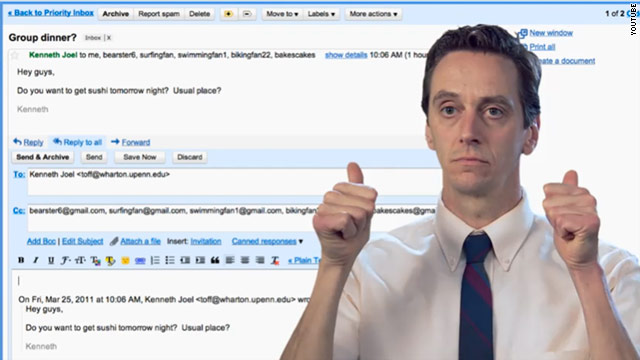
(CNN) -- Search giant Google on Friday debuted a "motion-controlled" e-mail system that lets users write digital messages by moving their bodies instead of typing on keyboards, which Google says are "outdated" and "inefficient."

"To open a message make a movement as if you were opening an envelope. To reply, simply point backward with your thumb," the company says in a video demonstration of the product, which seems to be a riff on Microsoft's Kinect gaming system. "To reply all, use both hands. To send a message, lick a stamp and place it down."

In case you haven't noticed, it's April 1, the day many corners of the internet start to look a lot like TheOnion.com.

Google, always the king of digital April Fools' jokes, played several pranks on the hopefully knowing public on Friday morning. Among them: motion-controlled e-mail, a YouTube roundup of viral videos from 1911 and a statement that says Google soon will change all of its fonts to the much-reviled Comic Sans.


Best April Fools' pranks RELATED TOPICS
Google Inc.
Groupon Inc.
HuffingtonPost.com Inc.
Internet
"Following some rigorous user testing of 41 different fonts, investigating how each affected user experience," Google writes, "we discovered one font consistently outperformed all others when it comes to user satisfaction, level of engagement, understanding Web content, productivity, click-through rates and conversion rates: Comic Sans."

People who search for "Comic Sans" on Google from certain browsers (Safari doesn't work, as far as we can tell) will see all their fonts changed to this bubbly typeface, which makes everything look like a ransom note written in crayon.

Google, of course, wasn't the only company to play some online tricks Friday. Here are a few of our other favorites:

HuffPo paywall: Mocking The New York Times' decision to start charging its frequent readers for access to its online articles, The Huffington Post on Friday announced a paywall of its own -- one that affects only employees of the Times.

"It's an important step that we hope you will see as an investment in The Huffington Post, one that will strengthen our ability to provide high-quality journalism to readers around the world -- and especially to our readers inside The New York Times," the company writes in a joke statement.

Royal wedding blog: Nearly a month before the scheduled nuptials, The Guardian on Friday unveiled a mock "live blog" to provide minute-by-minute updates on the wedding of Prince William and Kate Middleton. And they had a little fun with us, too.

"10.24 a.m.: More media news: our US correspondent Ed Pilkington reports that CNN will be sending 632 correspondents and commentators to cover the wedding, with the coverage on the day being helmed by Piers Morgan, sitting on a giant throne suspended from the upper level of Tower Bridge."

Angry Nerds: Software maker Atlassian served up a riff on the popular mobile game "Angry Birds" with this tablet-based "game," which lets players sling bespeckled geeks across the screen by launching them out of an office chair.

"What do you do when you have bugs in your code?" the site says. "Send in the Angry Nerds. Consider these issues ... resolved."

Job as Autocompleter: Another one from Google. The company mocks its own auto-complete feature, which guesses what users are searching for before they finish typing in a query. From the fake job posting:

"As a Google Autocompleter, you'll be expected to successfully guess a user's intention as he or she starts typing instantly. In a fraction of a second, you'll need to type in your prediction that will be added to the list of suggestions given by Google. Don't worry, after a few million predictions you'll grow the required reflexes."

Know Hemingway? You know that LinkedIn box that always recommends you connect with annoying former co-workers? On Friday, it's recommending dead famous people instead. Dear Ernest Hemingway, "I'd like to add you to my professional network."

Deals 4 Hipsters: If you're sick of those obnoxiously hip Groupon deals, check out the mock site Deals 4 Hipsters, which steals Groupon's format but offers discounts that are a little too trendy for their own good.

"Only $19 for a pair of lenseless frames ... $150 value, $800 if we had lenses in the frame." The deal is applicable only to residents of Inner West, Sydney.

Cobra documentary: Who doesn't love the Bronx Zoo cobra -- the venomous snake that went missing this week, tweeted up a storm and was captured Thursday? Animal Planet fake-announced it's making a special behind-the-scenes documentary about the snake's adventures while on the loose.

"Featuring never-before-seen footage, this renegade cobra's home movies and personal disclosures about why she slipped town will offer the real story behind the cobra's escape and solo adventures through New York City," the site says. "The documentary will also highlight the cobra's meteoric rise to fame and her interactions with the city's elite including Mayor (Michael) Bloomberg."

Apple 'Friend Bar': At The Onion, where April Fools' Day is just another Friday, there's a hilarious spoof on Apple's Genius Bar. They call it the Friend Bar, and it's a place where "specially trained" employees will listen to you talk about how much you love arcane Apple features for as long as you can rant:

"Unlike your girlfriend or your co-workers, we're not going to get tired of discussing the wireless networking capabilities of Snow Leopard Operating System. We're here and we're ready to listen," one of the fake workers says in a video segment about the new feature.

Playmobil Apple Store Playset: Feeling some iPad 2 line withdrawal? ThinkGeek offers a parody playset that lets you re-enact the fun of waiting in an Apple Store line with the help of plastic figurines.

The bloggers couldn't resist some of the features:

"A quick peek at the miniature Genius Bar and we were feeling a bit woozy. Then we saw the tiny Steve Jobs presenting in the Keynote Theater on the top floor and that was it. Our wallets popped out faster than you can say Jonathan Ive and we plunked down whatever money was needed to own this amazing playset."

Reff:http://edition.cnn.com/2011/TECH/web/04/01/april.fools.online/index.html

  • Digg
  • Del.icio.us
  • StumbleUpon
  • Reddit
  • RSS

5 ways Twitter changed how we communicate


(CNN) -- Happy birthday, @twitter.

The groundbreaking microblogging site, which has alternately been called a powerful tool for democracy and an emblem of all that's wrong with our short-attention-span digital age, turns 5 years old today.

On March 21, 2006, CEO Jack Dorsey wrote the post that started it all: "just setting up my twttr."

(For the record, Twitter, on its official blog, describes a message from Dorsey that appears to have been posted a few minutes later, "inviting coworkers," as the first official tweet.)

Since then, the site has picked up about 200 million users, making it one of the most-visited services on the Web.

In honor of its fifth birthday, here's a look at five ways Twitter has changed the digital communication game.

1. Made a fast flow of information faster

It's decade-old news that the internet helps information -- some of it good, some of it Snopes.com rumors -- spread fast.

With Twitter, it's fast on steroids.

In the Twitter echo chamber, all it takes is a few users with big follower counts to share something. With one click, those followers share it with their own followers. And the wildfire is set ablaze.

As a result, news spreads faster than ever. Twitter's real-time news flow has been cited as a tool in citizen uprisings in Iran and Egypt and as invaluable for fundraising efforts for crisis situations like last year's floods in Haiti.

But it also means internet hokum can go viral before anyone can put the brakes on it.

No shortage of celebrities have "died" on Twitter, so far. And the casualties will most likely continue to mount.

2. Removed the celebrity filter

For as long as the concept of "celebrity" has existed, there have been people paid to keep those celebrities from looking like jackasses in public.

Thankfully for us, Twitter ended all that.

OK, not completely. But musicians, actors, athletes and other stars who have taken to Twitter tend to share a lot more about themselves than most publicists would endorse. (We're looking at you, Charlie Sheen.)

And not just scandalous stuff (although we enjoyed Kanye West's bizarre round of self-flagellation just like everybody else).

Writers share tips and give fans a glimpse at their process. Lots of stars chat with their followers, giving fans unprecedented access. Photos, or even just updates on their everyday lives, let fans see stars in a way they never could before.

The downside? You're liable to realize that at least one of your favorite people has terrible grammar and can't spell.

3. Created "thought leaders"

Twitter's list of 100 most popular accounts is dominated almost entirely by celebrities and traditional media outlets. (We're fond of No. 19.)

But nestled not terribly far below are hundreds of bloggers, podcasters and online journalists who have found a bigger audience on Twitter than they probably would have without it.

When a single tweet puts your thoughts in front of hundreds of thousands of people, you're able to help set the agenda in your community.

4. Strengthened the "second screen"

With Twitter, nobody has to watch a TV show by themselves again.

There are mobile apps that are tailored for TV, movies and other entertainment. But for real-time chatter, it's hard to match Twitter.

The advent of DVRs and streaming services like Hulu and Netflix was threatening to kill the idea that people needed to watch a show as it aired. But with Twitter (particularly thanks to hashtags), watching a show during air time lets you have a real-time conversation with thousands of fellow fans.

"TV shows become events, meaning people watch them as they happen," Twitter CEO Dick Costolo said last month. "We're so used to creating experiences for our users, but now our users are creating experiences for each other."

A telling detail? Twitter traffic increases by a factor of 30 whenever "Glee" is on. And during this year's Super Bowl, there were 4,000 tweets sent per second.

5. (Over)simplified the conversation

Some thoughts just can't be summed up in 140 characters.

For all its ability to provide quick blasts of information, critics have argued that Twitter dumbs down Web conversations that deserve to be fuller and more fleshed out.

Some self-aware bloggers have admitted that since the site emerged, they're more likely to shoot out a couple of tweets on a topic than write a full post.

And more than a few high-profile tweeters have had to come back and explain themselves after a post on the site was misinterpreted -- or just to correct their sloppy grammar and spelling. Sometimes, they make up words).

One flip side of Twitter's increased celebrity access is that it allows politicians and others in the spotlight to fire off tweets without opening themselves up to follow-up questions or having to fully explain their messages.

Remember all the members of Congress who tweeted during President Obama's 2009 economic speech instead of even pretending to pay attention?

When the leaders of a nation are debating important issues the same way we share a link to the latest comic from The Oatmeal, we might have a problem.

Reff:http://edition.cnn.com/2011/TECH/social.media/03/21/twitter.birthday.communication/index.html

  • Digg
  • Del.icio.us
  • StumbleUpon
  • Reddit
  • RSS

Firefox 4 downloaded 5 million times in first day


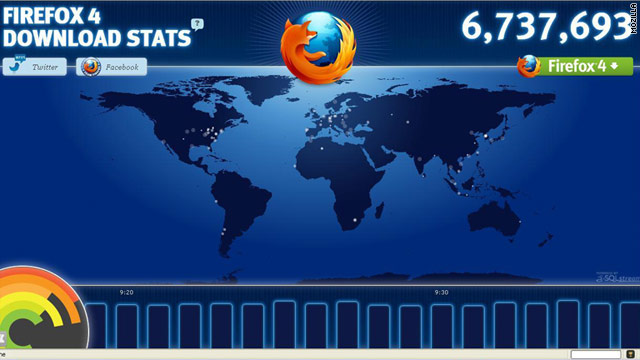
(CNN) -- Firefox 4, the latest version of Mozilla's free, open-source Web browser, was downloaded around 5 million times in its first 24 hours.

According to Mozilla's website, downloads were up to 6.8 million by 10 a.m. ET Wednesday, just over a day after the update was released.

Minutes before Firefox 4 turned a day old early Wednesday morning, it was on the verge of crossing 5 million, CNET noted.

That adoption rate is impressive. By comparison, Microsoft's Internet Explorer 9, rolled out last week, was downloaded about 2.3 million times during the first day it was available.

The latest version of Firefox features full support for emerging coding language HTML 5, tabs for apps, a redesigned user interface and a feature that helps users organize tabs for the websites they visit frequently.

It also includes a "do not track" feature, designed to tell sites you visit that you don't want to be tracked for advertising purposes. The sites still have to comply for it to work.

The browser is available for download in 80 languages on Windows, Mac and Linux and will be available soon on Android and Maemo devices, according to Mozilla.

Wednesday's number for Firefox is significantly less than the 8 million or so downloads for Firefox 3 in its first day in 2008. But Mozilla heavily promoted that release, telling users it wanted their help to set a world record for fast downloads.

Internet Explorer remains the Web's most popular browser, with about 43 percent of the market, according to analytics site StatCounter.

Firefox is second, and gaining, with about 30 percent. In third place is Google's Chrome browser, which has about 17 percent.

Reff: http://edition.cnn.com/2011/TECH/web/03/23/firefox.4.downloads/index.html

  • Digg
  • Del.icio.us
  • StumbleUpon
  • Reddit
  • RSS